Thursday, May 31, 2007

Treatment of Tendonitis- Quick Tips

What is the treatment of tendonitis?
Below is some advice for tendonitis treatment and avoiding recurrences of this problem. As with any treatment program, talk with your doctor before you begin tendonitis treatment! In order to aid healing you should:
Rest and Protect The Area
Tendonitis treatment must begin by avoiding aggravating movements. This may mean taking a break from a favorite activity for a period of time, but this is a necessary step to allow the inflamed tendon to heal. It is also recommended in tendonitis treatment to try alternative activities; for example, if you are a runner who is experiencing knee pain due to tendonitis, try incorporating swimming into your workout schedule. Often a splint or brace will be prescribed to help protect the area.
Apply an Ice Pack
Icing the area of inflammation is an important aspect of tendonitis treatment.
The ice will help to control the inflammation and decrease swelling. By minimizing inflammation and swelling, the tendon can return to its usual state and perform its usual function.
Take Anti-Inflammatory MedicationsNonsteroidal anti-inflammatory medications (NSAIDs) include a long list of possibilities such as Ibuprofen, Motrin, Naprosyn, Celebrex, and many others.
Tendonitis treatment can be improved by these medications that will decrease pain and swelling. Be sure to talk to your doctor before starting these medications.
Cortisone InjectionsIf the symptoms of tendonitis are persistent, an injection of cortisone may be considered. Cortisone is a powerful anti-inflammatory medication, but instead of being given by mouth, it is injected directly to the site of inflammation. This can be extremely helpful for situations that are not improved with rest.
Not all types of tendonitis can be addressed with cortisone injections! For example, Achilles tendonitis is rarely injected with cortisone because of concerns about possible rupture of the tendon.
To prevent the return of tendonitis symptoms:
Strengthening and Physical TherapyProper strengthening technique can help you avoid tendonitis by using your muscles in a safe, more efficient manner. For example, patients with rotator cuff tendonitis can learn ways to move the shoulder that will not cause inflammation. Do not begin exercises until the inflammation of tendonitis has resolved!
Take BreaksAlternate repetitive tasks with breaks to relieve stress on the tendons. Don't perform one activity continuously for hours at a time. For those with exercise-related tendonitis, try to vary your workouts to relieve the repetitive stress of one exercise activity.
Protect the TendonsSome patients who have chronic tendonitis will find relief by protecting the affected area when performing certain activities. For example, wrist splints can be worn while gardening, or Chopat straps (patellar tendonitis) can be worn while playing sports.
The steps listed above are usually adequate tendonitis treatment, and most patients have resolution of their symptoms. Learning to avoid activities that may cause a tendonitis flare-up can also be important.
Tendonitis due to underlying conditions such as arthritis and gout are more difficult to treat and recur more frequently. The best management in these situations is to do your best to avoid flare-ups of gouty attacks or arthritic episodes, and to avoid activities which you have learned cause tendonitis.

Wednesday, May 30, 2007

What is athlete's foot?Athlete’s foot is a common fungal infection of the skin of your feet. The fungus, tinea pedis, is contracted from public environments. The fungus then grows in the warm and moist environment of your footwear, and can be difficult to eradicate.

Where did I get a athlete's foot from?Many cases of athlete’s foot can be traced to use of a public recreational facility, such as a spa, swimming pool, or locker room shower. The fungus, which grows in warm, moist environments, likes to live in the outer layers of your skin. However, for short periods of time, the fungus can live in warm puddles on the tile floor, awaiting another foot to hop onto.

What are the symptoms of athlete’s foot?Most commonly, people experience the typical symptoms of athlete’s foot:
Itching, most notably in the creases between your toes
Redness and scaling of the skin in affected areas
Cracked or blistered skin.

Tuesday, May 29, 2007

Common Types of Tendonitis

· Wrist TendonitisWrist tendonitis is a common problem that can cause pain and swelling around the wrist. Wrist tendonitis is due to inflammation of the tendon sheath. Treatment of wrist tendonitis usually does not require surgery.
· Achilles TendonitisAchilles tendonitis causes pain and swelling in the back of the heel. Understanding this common problem can help with treatment and help to avoid serious complications such as Achilles tendon rupture.
· Patellar (Kneecap) TendonitisPatellar tendonitis, or inflammation of the patellar tendon, is a condition often called Jumper's Knee. Treatment of patellar tendonitis usually consists of rest and anti-inflammatory medication.
· Rotator Cuff TendonitisMany patients who have pain are told by their doctor they have shoulder bursitis or rotator cuff tendonitis; learn more about rotator cuff tendonitis and available treatments.

Monday, May 28, 2007

Diagnosis of Tendonitis

How is tendonitis diagnosed?
Tendonitis is almost always diagnosed on physical examination. Findings consistent with tendonitis include:
Tenderness directly over the tendon
Pain with movement of muscles and tendons
Swelling of the tendon
Are X-rays or MRIs needed to diagnose tendonitis?Studies such as x-rays and MRIs are not usually needed to make the diagnosis of tendonitis. While they are not needed for diagnosis of tendonitis, x-rays may be performed to ensure there is no other problem, such as a fracture, that could be causing the symptoms of pain and swelling. X-rays may show evidence of swelling around the tendon.
MRIs are also good tests identify swelling, and will show evidence of tendonitis. However, these tests are not usually needed to confirm the diagnosis; MRIs are usually only performed if there is a suspicion of another problem.

Sunday, May 27, 2007

Quick Overview for the new ones

What is tendonitis?Sometimes the tendons become inflamed for a variety of reasons, and the action of pulling the muscle becomes irritating. If the normal smooth gliding motion of your tendon is impaired, the tendon will become inflamed and movement will become painful. This is called tendonitis, and literally means inflammation of the tendon.
What causes tendonitis?The most common cause of tendonitis is overuse. Commonly, individuals begin an exercise program, or increase their level of exercise, and begin to experience symptoms of tendonitis. The tendon is unaccustomed to the new level of demand, and this overuse will cause an inflammation and tendonitis.
Another common cause of symptoms of tendonitis is due to age-related changes of the tendon. As people age, the tendons loose their elasticity and ability to glide as smoothly as they used to. With increasing age, individuals are more prone to developing symptoms of tendonitis. The cause of these age-related changes is not entirely understood, but may be due to changes in the blood vessels that supply nutrition to the tendons.
Sometimes, there is an anatomical cause for tendonitis. If the tendon does not have a smooth path to glide along, it will be more likely to become irritated and inflamed. In these unusual situations, surgical treatment may be necessary to realign the tendon.

Friday, May 25, 2007

Tendons are:

A tendon is a tough yet flexible band of fibrous tissue. The tendon is the structure in your body that connects your muscles to the bones. The skeletal muscles in your body are responsible for moving your bones, thus enabling you to walk, jump, lift, and move in many ways. When a muscle contracts it pulls on a bone to cause movements. The structure that transmits the force of the muscle contraction to the bone is called a tendon.
Tendons come in many shapes and sizes. Some are very small, like the ones that cause movements of your fingers, and some are much larger, such as your Achilles tendon in your heel. When functioning normally, these tendons glide easily and smoothly as the muscle contracts.

Wednesday, May 23, 2007

A Sufferer's Experience

Tendonitis Prevention for Programmers
Thomas Wang

The Beginning
My occupation is computer programming. The job involves significant amount of typing. About 3 years ago, I started to develop symptoms of hand tingling and numbness. These symptoms are associated with long stretchs of typing on keyboards. Gradually, these symptoms got worse, until I have to seek a doctor for treatment.
The doctor said I have tendonitis. If it becomes worse, then it would develop to full carpel tunnel syndrome. My computer career would be in big trouble.
What follows is a course of treatment and trouble shooting of the work environment. I am glad to say that today I am completely symptoms free. If the work environment is correctly set up, then there should be good chance to avoid the problems of tendonitis, or carpel tunnel syndrome.
Treatment
First on treatment. My treatment involves putting cold packs on my wrists. After the cold pack, Cortizone cream is ultra-sounded in the wrists area. This is received from Doctor ordered physical therapy. Physical therapy folks treat athletic injuries and work place injuries.
I have heard some doctors will just issue some Advil tablets and call it a day. This by itself is ineffective except for the lightest form of tendonitis.
Bandages and Splints
The usages of bandages are doubtful, because they can restrict blood flow, and make the symptom worse. Splints are somewhat controversial. Tight fitting splints suffer the same disadvantages as bandages.
A somewhat loose fitting splints may be useful in office, where it is a good visual excuse for not typing so much. However, personally I feel I did not get too much out of splints.
Hand Usage Reduction
One basic measure is to reduce the amount work using the hand. They can include typing, mousing, holding books, digging in the garden, washing dishes, video games, carrying babies, and playing tennis.
Prevention
What I learned most however is in the area of prevention. The prevention steps are very detailed. That is why I decided to write this web page, so you can see what I learned, and to apply the knowledge to your situations.
Chair
The most basic item is the work place chair. The chair should have good back support. The height of the chair should be adjustable to a comfortable height for you. The arm rest design is important. It is very bad to have your elbows to rest on hard arm rests for a long time. If you do tend to rest your elbows on the arm rests, then chairs with removable arm rests or adjustable arm rests are ideal. Move the arm rests away from your body so you are less likely to rest the elbows on them.
Recently I bought an office chair without arm rests. It worked pretty well.
Keyboard Height
The next item is the keyboard height. Usually a desk designed for writing will be too high for typing. A good typing height is a few inches lower than writing height. Just a little above the lap is usually a good keyboard height. Put the keyboard on your lap, and put your fingers on the home row. You should notice the keyboard is roughly the same height or slightly lower than your elbow.
How to reduce this keyboard height when the table is too high? There are a few options. You can put the keyboard on your lap. Although the mouse will be more of a problem if you use this simple method. Some office table will have an optional extension keyboard surface that can be adjusted in height. You can custom make a specially shaped acrylic sheet for lowering the keyboard.
I made one at a plastic hobby shop called 'Tap Plastic'. You give them the specification, and they will construct it for you.
Posture
The correct posture for typing is for your arms to hang down naturally from your shoulders, with fore-arm and hand held in horizontal position. Move the chair forward until the fingers reach the home row.
If the keyboard is too high, it can lead to a typing style that I call 'frog swimming'. The frog swimming typing style is very bad for blood circulation. Imagine the keyboard is so high that it is almost up to your shoulders. Your arm is not dropping down, but stretched out horizontally. Your fore-arm is bent inward, so if your hands are straight they will touch each other. In order to type however, you have to bend the hands outward to span the keyboard. This resembles the frog swimming style, right? If you are typing like this, you are sure to develop tendonitis.
While typing, it is important not to lean forward. Typing while leaning forward is much more straining than typing while sitting straight. If the screen font size is set too small, you may lean forward unconciously.
Wrist Rests
How about wrist rests? A SOFT wrist rest can be useful when the keyboard is at the right height. You palm can touch lightly with the soft wrist rest while you are not typing. Resting your wrists on the wrist rest WHILE you are typing is very bad. This will cut off blood circulation to the hand, with negative effects even if the wrist rest is soft. Pressing the wrists against a hard table surface while typing is absolutely the killer- guaranteed tendonitis.
Reaching for Mouse
After these ergonomic changes, I still have right shoulder pain. I was puzzled, until I found out this is due to my reaching out for the mouse pointer device.
Today's keyboards are usually rather wide. Therefore the mouse will have to be positioned to the far right side of the keyboard. Constantly reaching out for the mouse caused my right shoulder to hurt.
My solution was to use a mini-keyboard without the numeric key-pad. Now the mouse can be moved in at least 4 inches. My shoulder pain disappeared within a month. I think an alternate solution is to use a keyboard with built-in touch pad at the center. This would be compatible with the keyboard on the lap approach, as a bonus. The design of touch pad varies, so you will have to see if a particular model is suitable for you.
One more way I dealt with the mouse is to put the mouse on the left hand side of the keyboard, and use my left hand for mousing. It only took a few days before I am used to it.
Monitor Height
I have received some comments that computer monitor located below eye level can reduce neck and shoulder strain. I think this is a sound advice. Certainly a monitor set above eye level can increase neck straining.
I have seen my co-workers construct 'glare shields' out of cardboard boxes. It is glued to the top or side of the monitor to reduce light glare. From what I have seen, it worked well when glare is an issue.
Conclusion
I was able to become tendonitis free with the ergonomic changes outlined in this article. I wish you too, are able to stay pain free. Of course, a few rest breaks per day never hurt!

Tuesday, May 22, 2007

Baby Your Arm

Even after you feel you have overcome a case of Epicondylitis, be sure to continue babying your arm. Always warm up your arm for 5 to 10 minutes before starting any activity involving your elbow. And if you develop severe pain after use anyway, pack your arm in ice for 15 to 20 minutes and call your doctor.

Monday, May 21, 2007

Relief of Golfer's Elbow

The best way to relieve Medial Epicondylitis is to stop doing anything that irritates your arm. A simple step for the weekend athlete, but not as easy for the manual laborer, office worker, or professional athlete.
The most effective conventional and alternative treatments for Epicondylitis have the same basic premise: Rest the arm until the pain disappears, then massage to relieve stress and tension in the muscles, and exercise to strengthen the area and prevent re-injury. If you must go back to whatever caused the problem in the first place, be sure to warm up your arm for at least 5 to 10 minutes with gentle stretching and movement before starting any activity. Take frequent breaks.
For most mild to moderate cases of Epicondylitis, aspirin or ibuprofen will help address the inflammation and the pain while you are resting the injury, and then you can follow up with exercise and massage to speed healing. For stubborn cases of Epicondylitis your doctor may advise corticosteroid injections, which dramatically reduce inflammation, but they cannot be used long-term because of potentially damaging side effects.

Friday, May 18, 2007

These are the SYMPTOMS


Symptoms Of Golfer's Elbow
Tenderness and pain at the medial epicondyle, made worse by flexing the wrist. The pain may spread down the forearm. Activities that use the flexor muscles like bending the wrist or grasping can make matters worse.
Pain caused by lifting or bending the arm or grasping even light objects such as a coffee cup.
Difficulty extending the forearm fully (because of inflamed muscles, tendons and ligaments).
Pain that typically lasts for 6 to 12 weeks; the discomfort can continue for as little as 3 weeks or as long as several years.

Thursday, May 17, 2007

The Physiology Of Golfer's Elbow


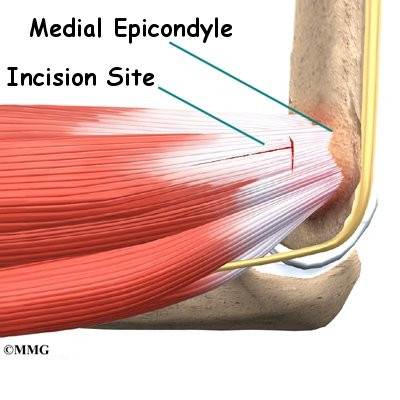
The muscles of the forearm that pull the wrist down are called wrist flexors. They begin at a common tendon attachment on the inside bump of the elbow called the medial epicondyle (below). As the wrist is flexed or the hand made to grip, the muscles tense and pull against the tendons. Force placed on the flexor muscles during a golf swing pulls on the tendons at the medial epicondyle.
Golfer’s Elbow, is similar to its counterpart, Tennis Elbow. The primary difference between the two is the location of the pain and the activity that leads to injury. However, both conditions are caused by overuse of the muscles of the forearm leading to inflammation and pain around the elbow joint.
These problems, Tennis Elbow and Golfer’s Elbow, are forms of tendonitis. Tendons are the ends of muscles that attach to bone. Because of the force of the muscle, the points of insertion of the tendon on the bone are often pointed prominences.
The medical names of Tennis Elbow (lateral epicondylitis) and Golfer’s Elbow (medial epicondylitis) come from the names of these bony prominences where the tendons insert, and where the inflammation causes the pain. The pain of Golfer’s Elbow is usually at the elbow joint on the inside of the arm; a shooting sensation down the forearm is also common while gripping objects.

Wednesday, May 16, 2007

At his best, Jason Akermanis has sublime skills and breathtaking pace but at three-quarter time on Sunday, Western Bulldogs supporters would have been forgiven for thinking their club had bought a lemon.Akermanis had just six possessions next to his name, one of which was a lame left foot shot at goal which dribbled along the ground.And to add insult to injury, Melbourne ruckman Paul Johnson had succeeded effortlessly in making Akermanis look slow.That was on top of a shocking start to the season, one which had seen him already miss two games due to injury with the four he had played being far from the lofty standards he set in a 248-game career with Brisbane where he was one of the game's premier midfielders.

Tuesday, May 15, 2007

Intro to Golfer's Elbow

Medial Epicondylitis is usually referred to as "Golfer's Elbow", not because only golfers develop the ailment, but because that activity is a common cause of the problem.
There are many other activities that can result in Golfer's Elbow such as working out at the gym or simply working in front of a computer for prolonged periods. Each of these activities use the same muscles repetitively and can result in the inflammation of muscles, ligaments & tendons.
Two additional strains, Lateral Epicondylitis (more commonly known as Tennis Elbow) and Bursitis, are often mistaken for Medial Epicondylitis.

Monday, May 14, 2007

Reasons to call a Doc

If you have ennis elbow, call a docor if:
The pain persists for more than a few days; chronic inflammation of the tendons can lead to permanent disability.
The elbow joint begins to swell; tennis elbow rarely causes swelling, so you may have another condition such as arthritis, gout, infection or even a tumor.

Friday, May 11, 2007

Preventing a relapse

To prevent a relapse of tennis elbow:
Discontinue or modify the action that is causing the strain on your elbow joint. If you must continue, be sure to warm up for 10 minutes or more before any activity involving your arm, and apply ice to it afterward. Take more frequent breaks.
Try strapping a band around your forearm just below your elbow. If the support seems to help you lift objects such as heavy books, then continue with it. Be aware that such bands can cut off circulation and impede healing, so they are best used once tennis elbow has disappeared.

Thursday, May 10, 2007

This is how to prevent tennis elbow

To prevent tennis elbow:
Lift objects with your palm facing your body.
Try strengthening exercises with hand weights. With your elbow cocked and your palm down, repeatedly bend your wrist. Stop if you feel any pain.
Stretch relevant muscles before beginning a possibly stressful activity by grasping the top part of your fingers and gently but firmly pulling them back toward your body. Keep your arm fully extended and your palm facing outward.

Wednesday, May 9, 2007

When you should consider seeing a doctor

If rest, anti-inflammatory medications, and a stretching routine fail to cure your tennis elbow, you may have to consider surgery, though this form of treatment is rare (fewer than 3 percent of patients). One procedure is for the tendon to be cut loose from the epicondyle, the rounded bump at the end of the bone, which eliminates stress on the tendon but renders the muscle useless. Another surgical technique involves removing so-called granulated tissue in the tendon and repairing tears.
Even after you feel you have overcome a case of tennis elbow, be sure to continue babying your arm. Always warm up your arm for 5 to 10 minutes before starting any activity involving your elbow. And if you develop severe pain after use anyway, pack your arm in ice for 15 to 20 minutes and call your doctor.

Tuesday, May 8, 2007

Relief Of Tennis Elbow


The best way to relieve tennis elbow is to stop doing anything that irritates your arm — a simple step for the weekend tennis player, but not as easy for the manual laborer, office worker, or professional athlete.
The most effective conventional and alternative treatments for tennis elbow have the same basic premise: Rest the arm until the pain disappears, then massage to relieve stress and tension in the muscles, and exercise to strengthen the area and prevent re-injury. If you must go back to whatever caused the problem in the first place, be sure to warm up your arm for at least 5 to 10 minutes with gentle stretching and movement before starting any activity. Take frequent breaks.
Conventional medicine offers an assortment of treatments for tennis elbow, from drug injections to surgery, but the pain will never go away completely unless you stop stressing the joint. Re-injury is inevitable without adequate rest.
For most mild to moderate cases of tennis elbow, aspirin or ibuprofen will help address the inflammation and the pain while you are resting the injury, and then you can follow up with exercise and massage to speed healing.
For stubborn cases of tennis elbow your doctor may advise corticosteroid injections, which dramatically reduce inflammation, but they cannot be used long-term because of potentially damaging side effects.

Monday, May 7, 2007

Tennis Elbow

Symptoms Of Tennis Elbow
Recurring pain on the outside of the upper forearm just below the bend of the elbow; occasionally, pain radiates down the arm toward the wrist.
Pain caused by lifting or bending the arm or grasping even light objects such as a coffee cup.
Difficulty extending the forearm fully (because of inflamed muscles, tendons and ligaments).
Pain that typically lasts for 6 to 12 weeks; the discomfort can continue for as little as 3 weeks or as long as several years.
The damage that tennis elbow incurs consists of tiny tears in a part of the tendon and in muscle coverings. After the initial injury heals, these areas often tear again, which leads to hemorrhaging and the formation of rough, granulated tissue and calcium deposits within the surrounding tissues. Collagen, a protein, leaks out from around the injured areas, causing inflammation. The resulting pressure can cut off the blood flow and pinch the radial nerve, one of the major nerves controlling muscles in the arm and hand.
Tendons, which attach muscles to bones, do not receive the same amount of oxygen and blood that muscles do, so they heal more slowly. In fact, some cases of tennis elbow can last for years, though the inflammation usually subsides in 6 to 12 weeks.
Many medical textbooks treat tennis elbow as a form of tendonitis, which is often the case, but if the muscles and bones of the elbow joint are also involved, then the condition is called epicondylitis. However, if you feel pain directly on the back of your elbow joint, rather than down the outside of your arm, you may have bursitis, which is caused when lubricating sacs in the joint become inflamed. If you see swelling, which is almost never a symptom of tennis elbow, you may want to investigate other possible conditions, such as arthritis, infection, gout or a tumor.
source-tennis-elbow.net

Friday, May 4, 2007

Treatment for kinds of tendonitis

For most mild to moderate cases of tendonitis, aspirin or ibuprofen will help address the inflammation and the pain while you are resting the injury, and then you can follow up with exercise and massage to speed healing.
For stubborn cases of tendonitis your doctor may advise corticosteroid injections, which dramatically reduce inflammation, but they cannot be used long-term because of potentially damaging side effects.Another attractive option for many sufferers, especially those who prefer to not ingest medication orally, is the application of an appropriate and effective topical anti-inflammatory.

Thursday, May 3, 2007

The best way

The best way to relieve tendonitis is to stop doing anything that irritates the body part in question — a simple step for the weekend tennis player or morning jogger, but not as easy for the manual laborer, office worker, or professional athlete.
The most effective conventional and alternative treatments for tendonitis have the same basic premise: Rest until the pain disappears, then massage to relieve stress and tension in the muscles, and exercise to strengthen the area and prevent re-injury. If you must go back to whatever caused the problem in the first place, be sure to warm up for at least 5 to 10 minutes with gentle stretching and movement before starting any activity. Take frequent breaks.
Conventional medicine offers an assortment of treatments for tendonitis, from drug injections to surgery, but the pain will never go away completely unless you stop stressing the joint. Re-injury is inevitable without adequate rest.

Wednesday, May 2, 2007

All types of tendonitis

• Medial Epicondylitis (aka golfers elbow, baseball elbow, suitcase elbow)Caused by forceful wrist flexion and pronation injuring the tendons that attach to the medial epicondyle of the humerus.Symptoms: Pain in the flexor pronator tendons and medial aspect of elbow when the wrist is flexed or rotated outward against resistance.
• Lateral Epicondylitis (tennis elbow)Caused by continued stress on grasping muscles of the hand on rotation so the forearm faces upward or forward.Symptoms: Pain in the lateral epicondyle of the elbow when the wrist is extended against resistance.
• Rotator Cuff Tendonitis (swimmers shoulder, tennis shoulder, pitchers shoulder)Caused by sports that require movement of the arm over the head repeatedly causing inflammation on the rotator cuff—a group of muscles that control shoulder rotation.Symptoms: Pain initially when the arm is brought forward over the head, severe pain when bringing the arm across the chest.
• Peripatellar Tendonitis (jumpers knee)Caused by repetitive jumping, running, or cutting.Symptoms: Pain in the region of the kneecap during or after physical activity.
• Popliteus Tendonitis Caused by downhill running or walking.Symptoms: Pain in the side of the knee with downhill running.
• Achilles Tendonitis Caused by downhill running.Symptoms: Pain with dorsiflexion of foot usually while running.

Tuesday, May 1, 2007

Rotator Cuff and Achilles Tendonitis

Rotator Cuff Tendonitis
Shoulder
Cause & Symptoms
Often due to either a sudden violent movement of the shoulder or from chronic overuse. Sports commonly associated with this diagnosis include: Tennis, Swimming, Baseball, Softball and Football.

AchillesTendonitis
Ankle
Cause & Symptoms Excess Pronation (rolling over of the foot) causes extra strain on the tendon. Characterized by the slow onset of pain & swelling in the Achilles region that will worsen with physical activity. Pain will tend to be worse in the morning.